
How to Reconcile QuickBooks Online: A Step-by-Step Guide
Reconciling means checking your books against the bank statement for one month and confirming the two agree. Do it every month.
When an account reconciles, you know nothing is missing and nothing got entered twice. The cash number on your financial statements is correct.
This guide uses a checking account. The same steps work for savings, credit cards, and loans.
Before you start
- The statement for the period you are reconciling, including the transaction pages and not just the summary page.
- Last month already reconciled. If you are behind, start with the oldest month you have not done and work forward.
- Every transaction for the period entered and categorized in QuickBooks. Step two covers this.
One note on the example below. The sample month has 312 transactions, which is deliberately large so the checks are easy to see. A typical small business month is closer to 40 to 80. Your screen will look emptier than these screenshots, and that is fine.
Select any image to enlarge it. QuickBooks is currently rolling out new versions of both the banking and reconcile screens, so your buttons may sit in slightly different places. The steps are the same either way.
1. Connect the bank feed
If your account already downloads transactions, skip to step two.
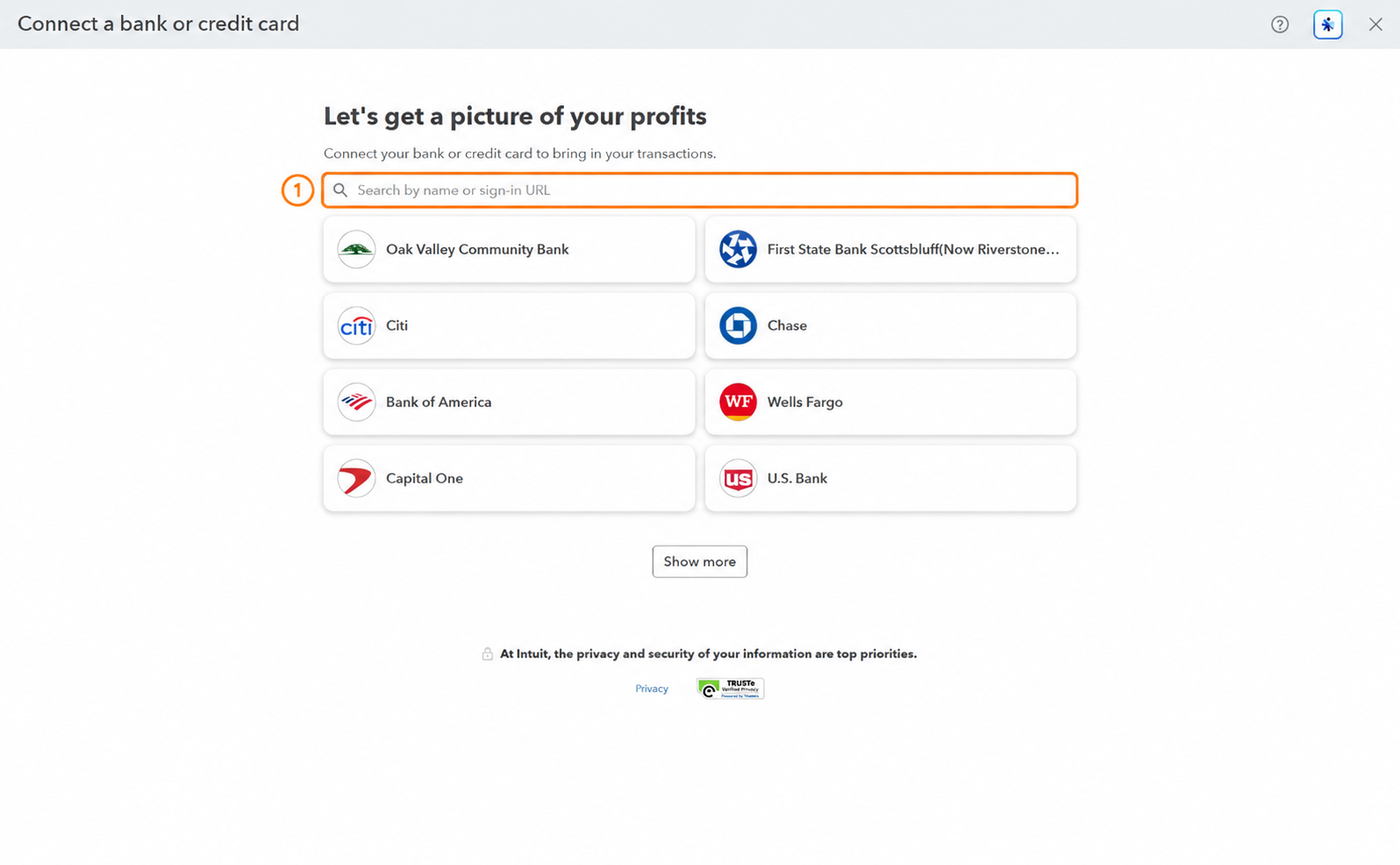
Go to Accounting, then Bank transactions, and select Link account. Search for your bank by name or by the web address you use to sign in, then follow your bank's prompts. If the account is already set up in QuickBooks, link to that existing account rather than creating a second one.
This connection is called a bank feed. It pulls transactions in for you to review. It does not put them into your books on its own.
If the feed does not go back far enough
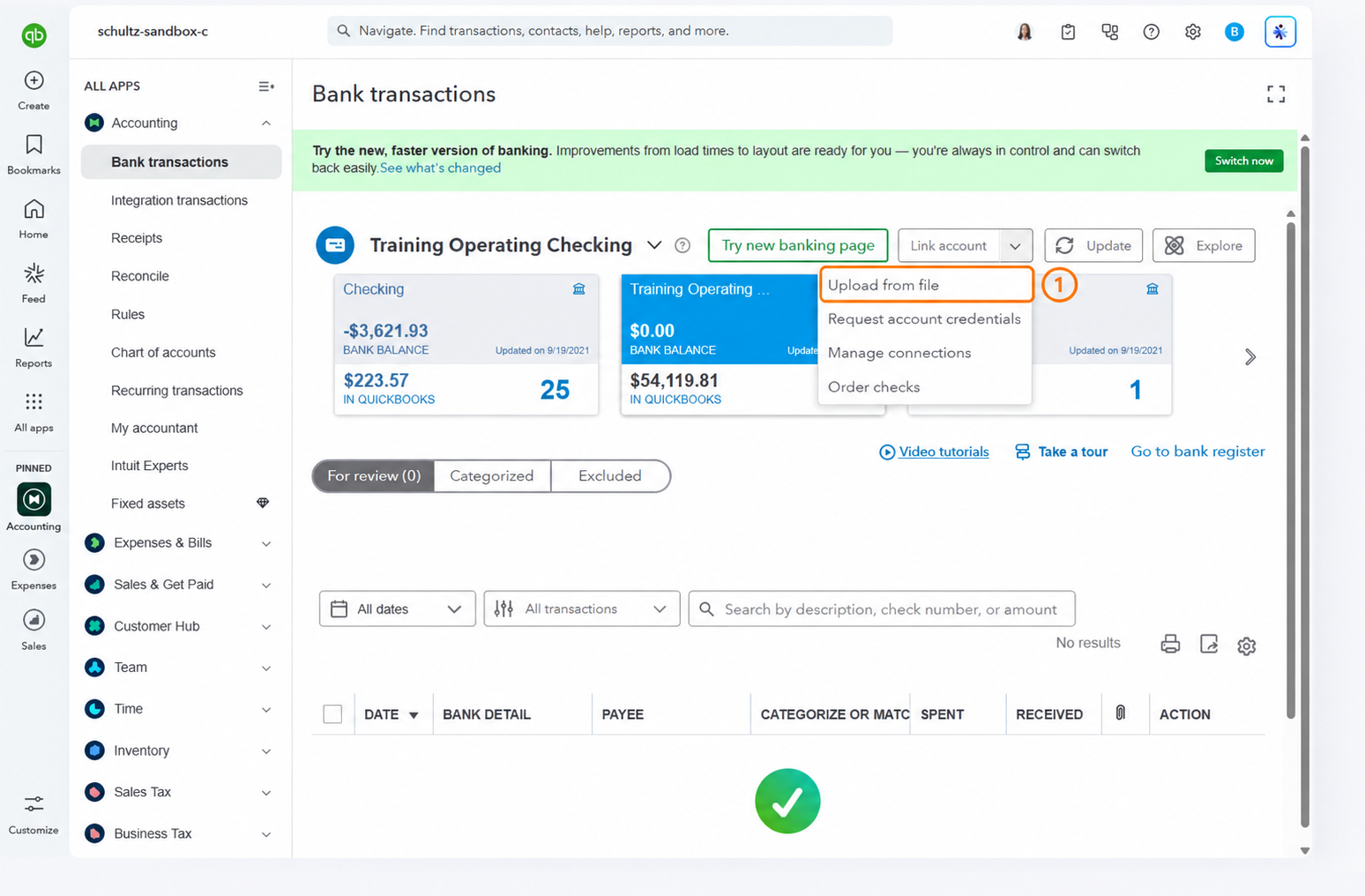
Bank feeds only reach back so far, and often not far enough to cover a statement from several months ago. Waiting will not fix it. Select the arrow next to Link account, choose Upload from file, and import the older transactions from a file your bank exports. Most banks offer a spreadsheet or QuickBooks download alongside the PDF statement.
2. Finish the coding before you reconcile
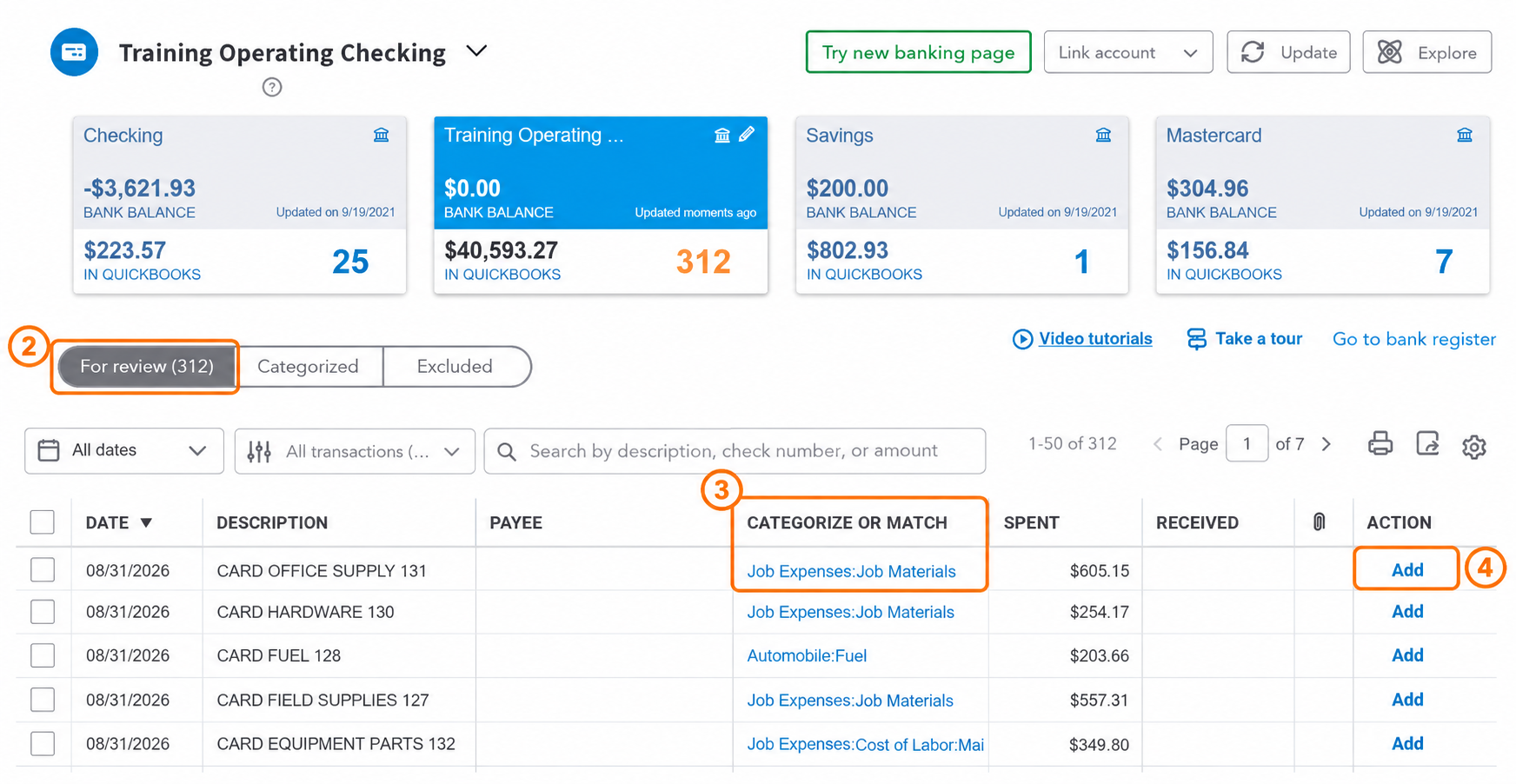
Coding means telling QuickBooks what each transaction was for, such as supplies, rent, or a payment against a loan. Open Bank transactions, pick your account, and go to the For review tab.
Do not start reconciling until For review is empty for the period on your statement. Reconciling compares your books to the statement. Anything still sitting in For review has not reached your books yet, and it will show up as a difference you cannot explain.
| What you find | What to do |
|---|---|
| It is already in QuickBooks | Check the details, then select Match. |
| It has not been entered yet | Set the payee and the correct category, then select Add. |
| It is on the statement but did not download | Check whether it is already in QuickBooks. If not, enter it before you reconcile. |
| You do not recognize it | Find the receipt before you pick a category. Do not guess. |
Match and Add are not the same thing. Match connects a download to an entry already in your books. Add creates a new one. Using Add on something already entered gives you the transaction twice.
Check the category QuickBooks suggests before you accept it. It guesses from the description and it is often wrong. Credit card payments and transfers deserve particular attention. A card payment reduces what you owe, so recording it as an expense counts the same purchases a second time.
A clean bank feed is not a reconciled account. Emptying For review means everything that downloaded has been filed somewhere. It does not prove the feed brought everything in, and it does not catch duplicates. Reconciling is what proves that.
3. Start the reconciliation
Here is the sample August statement this guide uses. It includes customer deposits, supplier payments, payroll, transfers, and fees.
| On the statement | Transactions | Amount |
|---|---|---|
| Beginning balance | $42,518.27 | |
| Deposits and other credits | 86 | $186,432.18 |
| Withdrawals and other debits | 226 | $172,905.64 |
| Ending balance, August 31, 2026 | $56,044.81 |
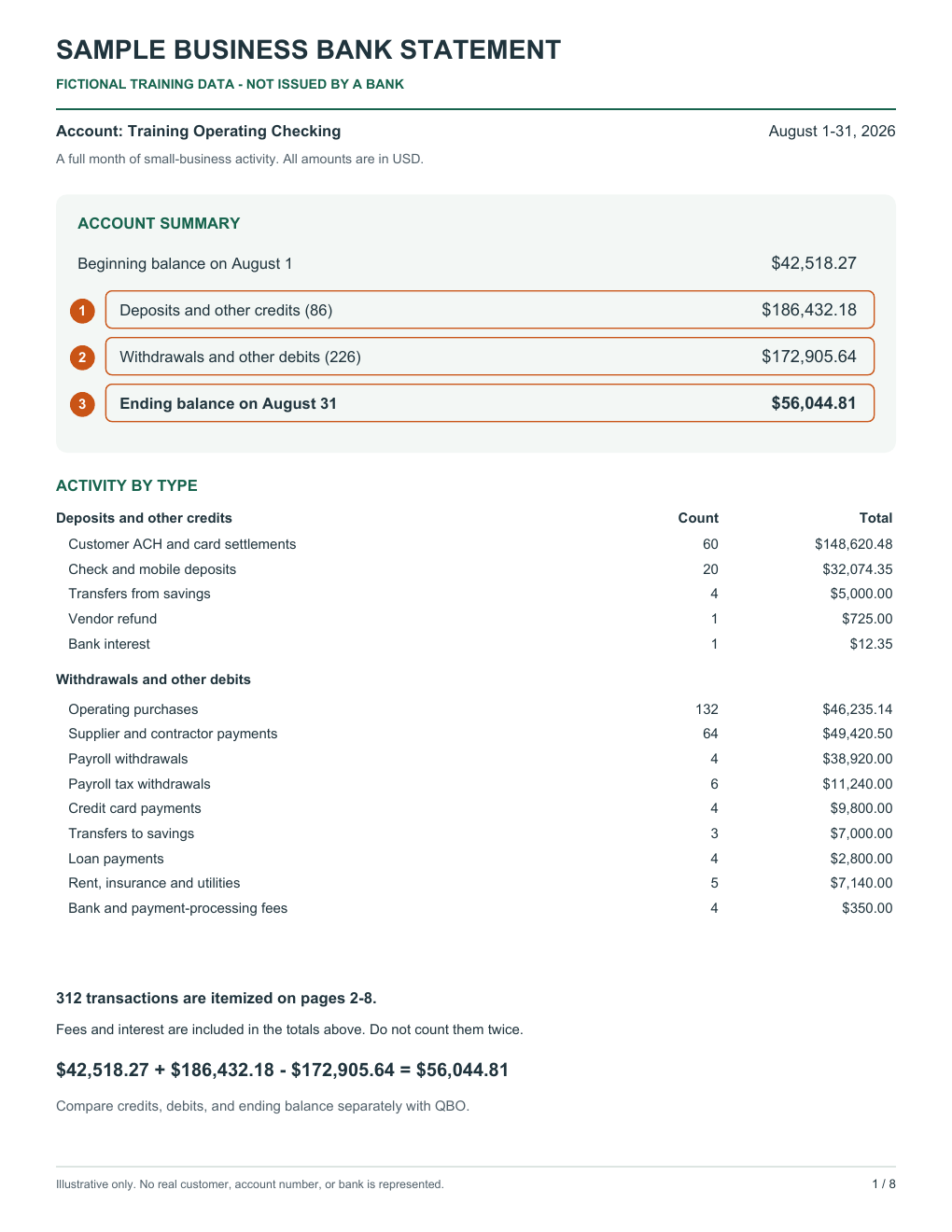
Download the full sample statement: 312 transactions (PDF)
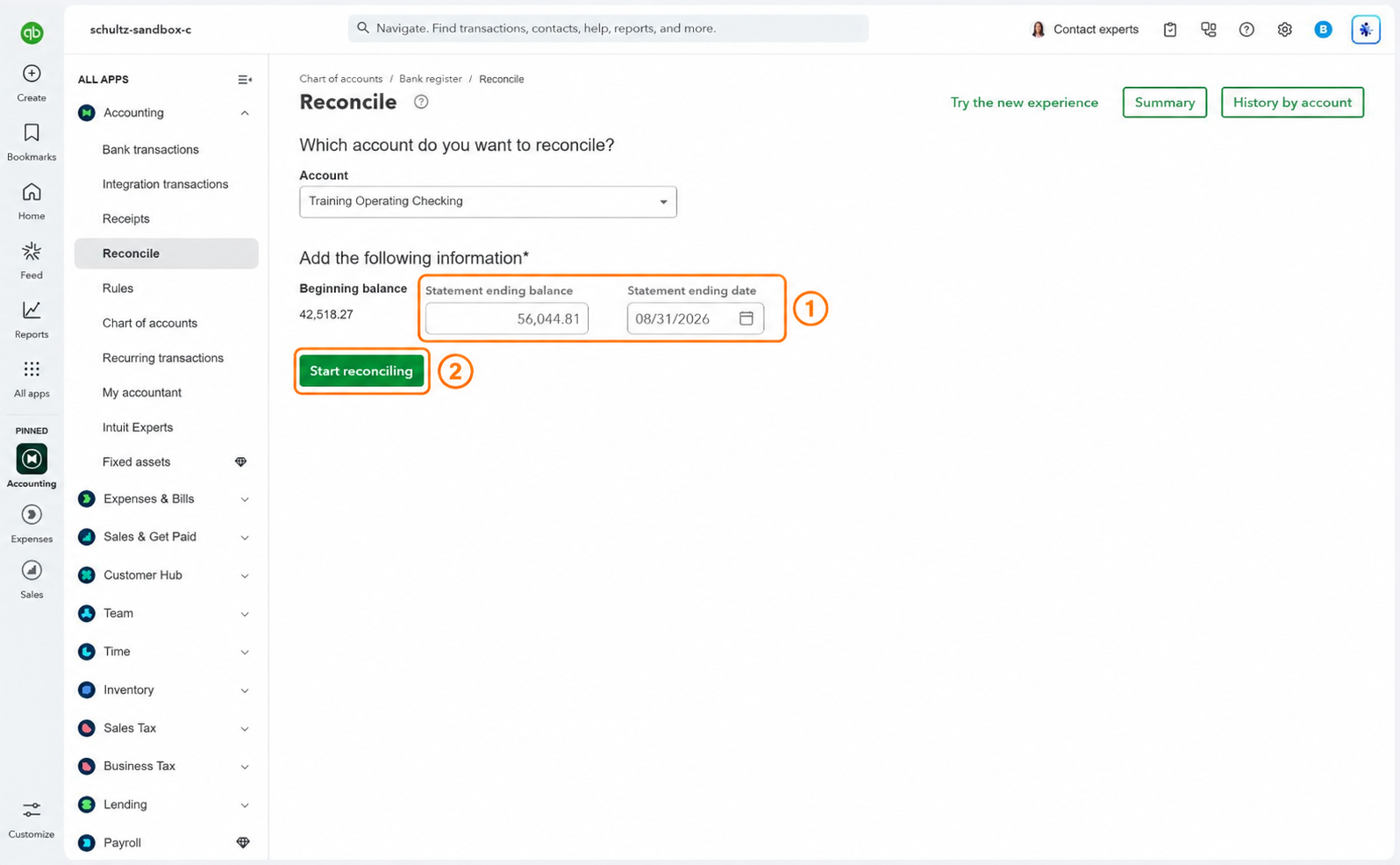
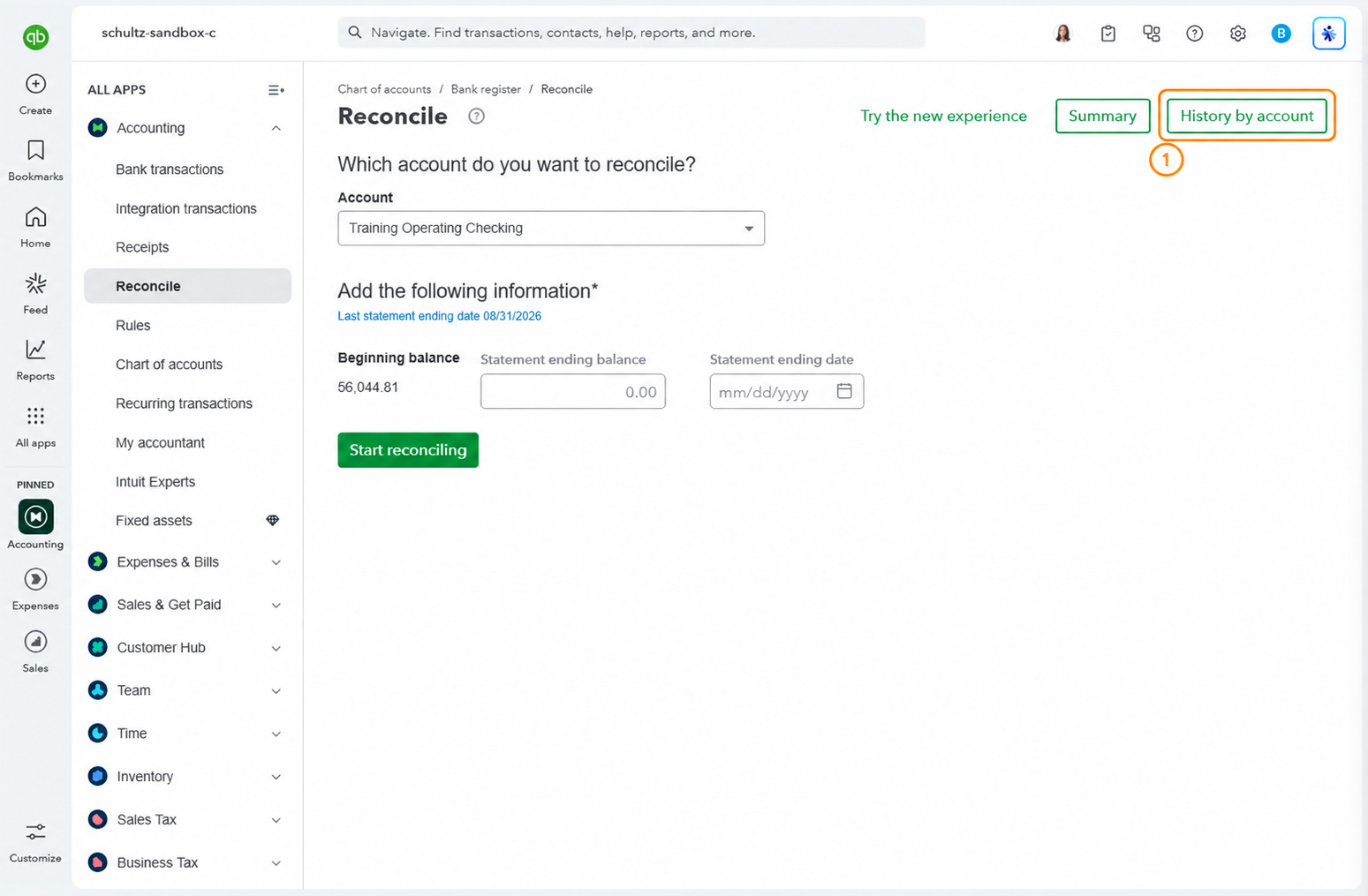
Go to Accounting, then Reconcile, and choose the account your statement is for.
QuickBooks shows a Beginning balance. Compare it to the beginning balance printed on your statement. In our example both are $42,518.27.
If the beginning balance does not match
Stop and find out why before going any further. There are two usual causes. Either a transaction that was part of an earlier reconciliation has since been edited, deleted, or redated, or the account's opening balance was wrong when it was first set up. Reconciling on top of a wrong beginning balance does not fix it, it just carries the problem forward another month.
Then enter the Statement ending balance and Statement ending date from your statement. In our example those are $56,044.81 and August 31, 2026. Use the balance printed on the statement, not the balance your bank's website shows today. Select Start reconciling.
4. Check off what cleared
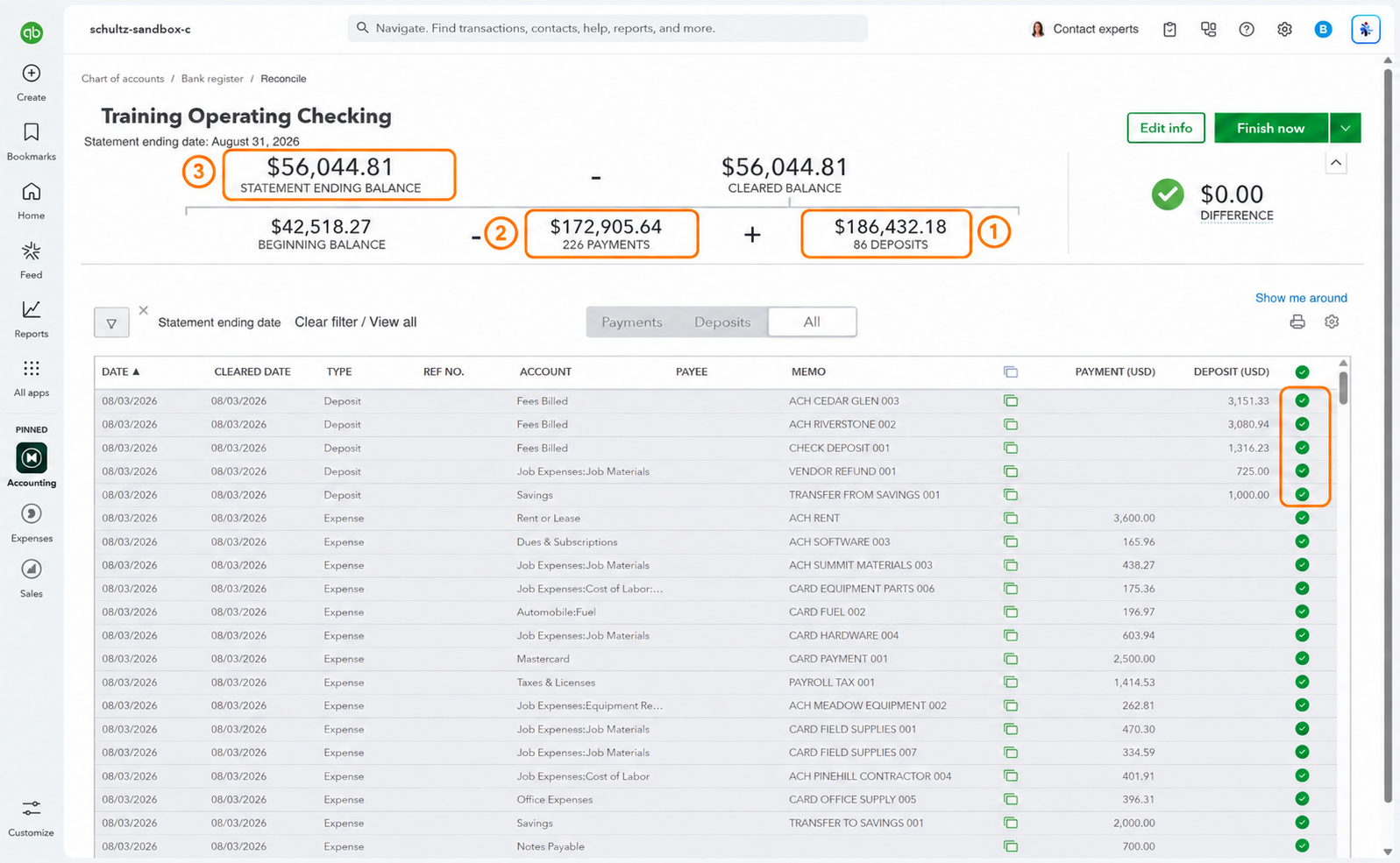
You are now marking which transactions in your books appear on the statement. Work the deposits first, then the payments, one statement page at a time.
- Find the statement transaction in the QuickBooks list.
- Compare the amount first, then the date and the check or reference number. The bank's date can be a day or two later than yours.
- Select the circle at the right of the row to mark it cleared.
Review anything QuickBooks has already marked for you rather than assuming it is right. If a single deposit combines several customer payments, use the deposit detail or your payment processor's report to confirm the total.
Leave a transaction unchecked if it is not on this statement. That includes anything dated after your statement ending date. These are not errors. A check you wrote on the 29th that nobody has cashed belongs in your books and not on this statement. Our example has four outstanding checks totaling $5,300 and two deposits totaling $3,375 that had not cleared by the 31st. Those six stay unchecked.
If something on the statement is missing from QuickBooks, you do not have to start over. Save your progress, go enter the transaction, then come back to Reconcile. Your checked items will still be there.
5. Compare all three totals
This is the step most people skip, and it is the one that catches real errors. Check three numbers separately instead of trusting the difference on its own.
| Check in QuickBooks | Match it to the statement | August example |
|---|---|---|
| Selected deposits | Total deposits and credits | $186,432.18 |
| Selected payments | Total withdrawals and debits | $172,905.64 |
| Cleared balance | Ending balance | $56,044.81 |
Here is why all three matter. Suppose a $1,250 customer deposit and a $1,250 supplier payment are both left unchecked.
| Check | Selected in QuickBooks | Does it match? |
|---|---|---|
| Deposits | $185,182.18 | No, $1,250 short |
| Payments | $171,655.64 | No, $1,250 short |
| Cleared balance | $56,044.81 | Yes |
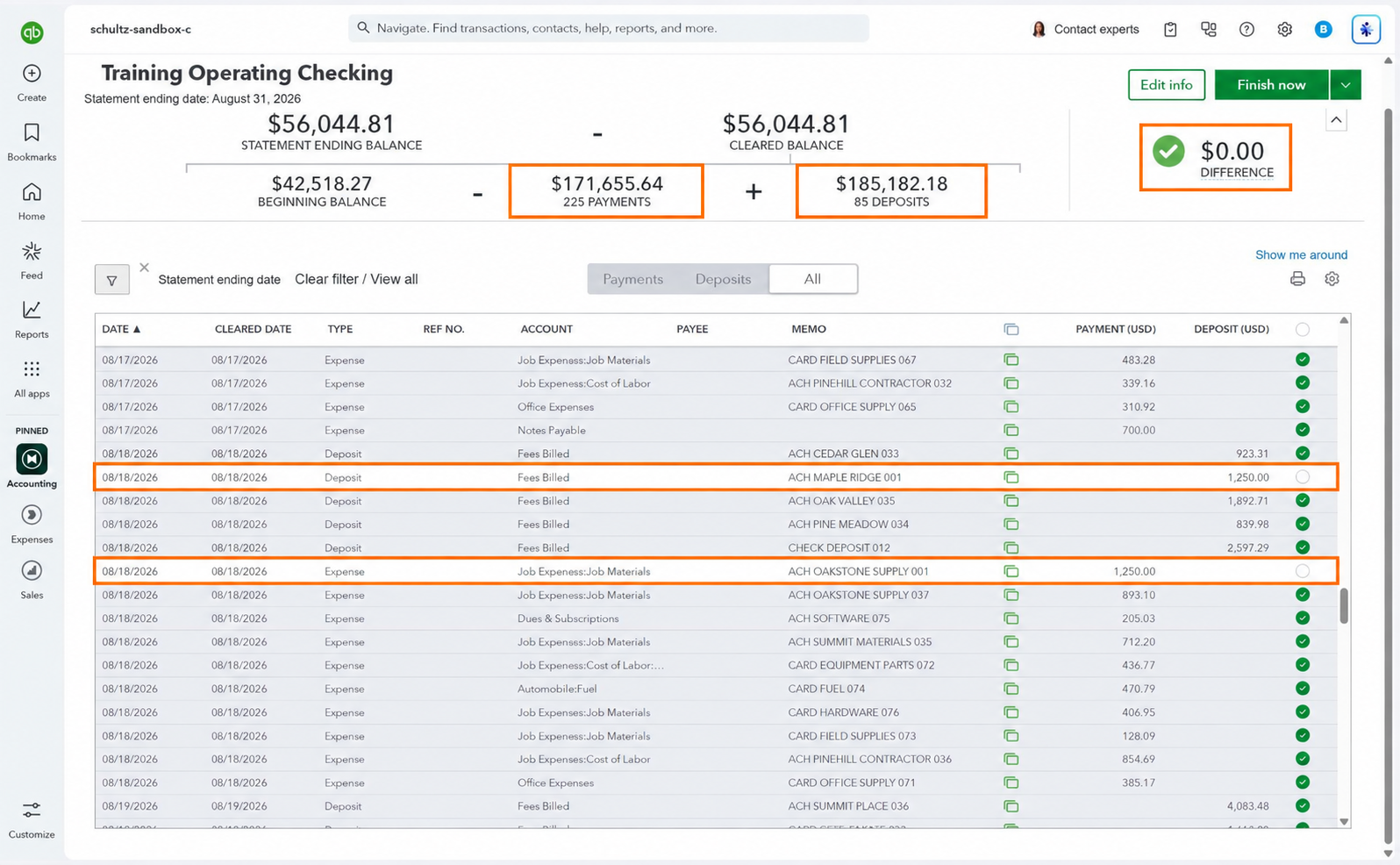
The two omissions cancel each other out. The difference reads $0.00 and QuickBooks will happily let you finish, but two real transactions are unaccounted for. Comparing deposits and payments separately catches this. Watching only the difference does not.
If your statement shows transaction counts, compare those too. Our example has one entry in QuickBooks for every line on the statement: 86 deposits and 226 payments.
Include bank fees and interest in the comparison, and check whether your statement already folds them into its totals. On a credit card the same three-way check applies to charges, payments, interest, fees, and refunds.
6. When it does not match
| What you are seeing | Check this first |
|---|---|
| A transaction is missing | The account and date filters, then whether it was ever entered. |
| A total is too high | Duplicates, or items checked that are not on this statement. |
| A total is too low | Unchecked entries, bank fees, or interest you have not recorded. |
The size of the difference is itself a clue. If you are off by exactly the amount of one transaction, that is the transaction to look for. If the difference divides evenly by nine, two digits are usually transposed somewhere, such as 54 entered as 45. If it is exactly double a transaction on the statement, something is entered with the wrong sign or checked twice.
Never force it. Do not post an adjustment to make the difference zero. That does not fix anything. It buries the error in your books, where it will surface later as a number nobody can explain.
If you finished a reconciliation by mistake
It can be undone. Go to Reconcile, then History by account, and find the reconciliation. Undoing a completed reconciliation is not available on every subscription, so if you do not see the option, we can undo it from our accountant access.
7. Finish and save the report
When all three totals agree, the difference is $0.00, and you can account for everything still unchecked, select Finish now. Save the reconciliation report alongside the statement. You can find it again under Reconcile, then History by account.
Why your books will not match the bank
After a clean reconciliation your books still show a different number than the statement, and that is correct. The statement stops at what cleared by the 31st. Your books include everything you have recorded.
| August example | Amount |
|---|---|
| Statement ending balance | $56,044.81 |
| Add deposits that had not cleared | $3,375.00 |
| Less checks that had not been cashed | ($5,300.00) |
| Balance in your books | $54,119.81 |
That $54,119.81 is the figure that belongs on your balance sheet.
What reconciling does not catch
A reconciled account proves every transaction is present and correct in amount. It does not prove any of them are in the right category. A supplier payment coded to the wrong expense account reconciles perfectly. Once you have finished, read through your Profit and Loss and Balance Sheet and look for anything that seems off.
Do this for every business bank and credit card account, every month.
If you get stuck, or you are off by an amount you cannot track down, send us the statement, the amount of the difference, and what you have already checked, and we will pick it up from there.