
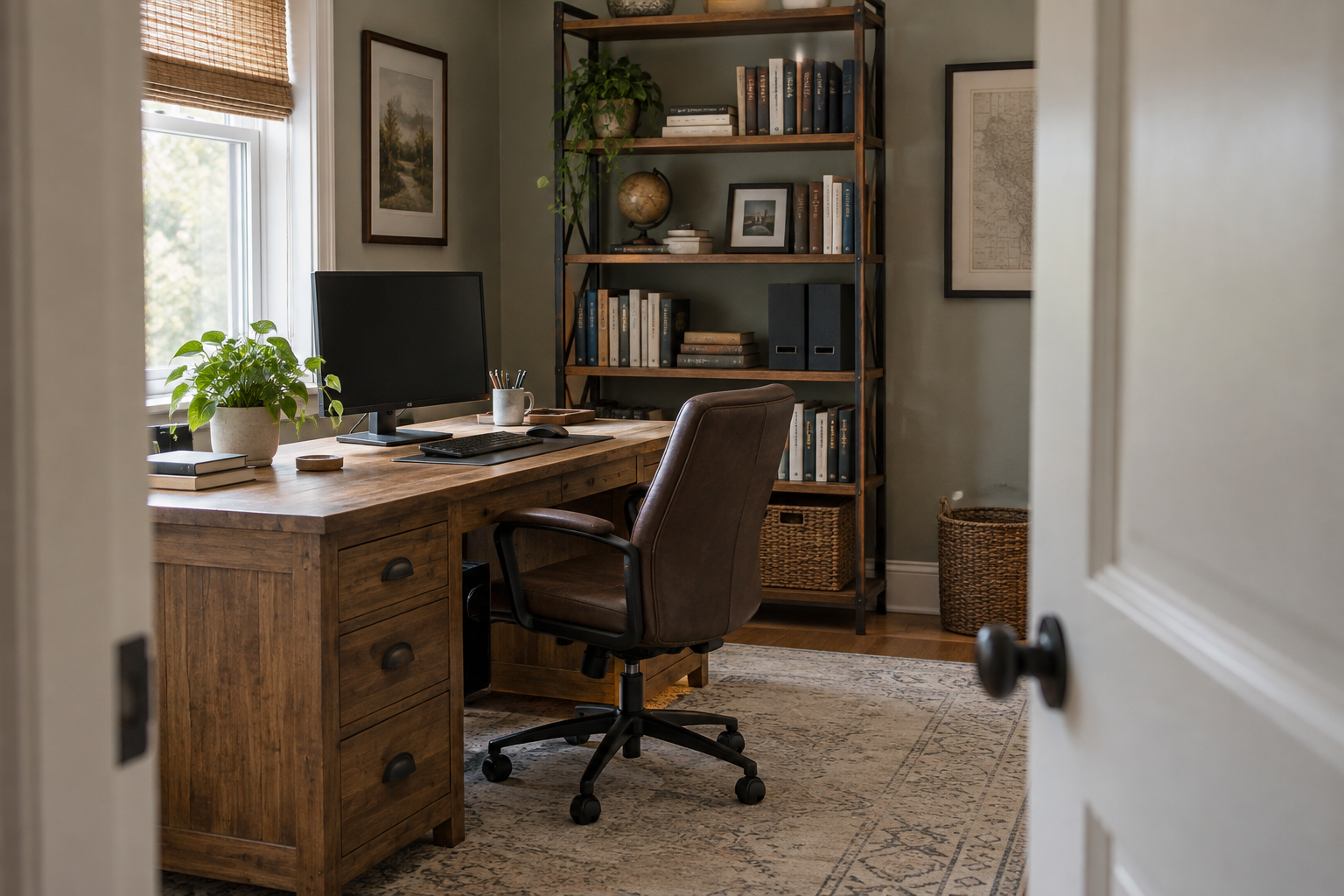
The Home Office Deduction: Simplified or Actual Expenses?
If you're self-employed and have a qualifying home office, you can generally choose between two ways to calculate the deduction: a flat amount based on square footage or a share of your actual home expenses.
The simplified method uses $5 per square foot, up to 300 square feet. That means a maximum deduction of $1,500 for a full qualifying year, before the business-income limit. It involves less calculation, but the actual-expense method may produce a larger deduction.
The space must qualify first
For an ordinary home office, you generally need a specific area used regularly and exclusively for your business. A room used for work and family activities usually doesn't pass the exclusive-use test. A separately identifiable work area can qualify without being a separate room.
The space also generally must be one of the following:
- Your principal place of business.
- A place where you regularly meet clients, customers, or patients in person as a substantial part of your business.
- A separate, unattached structure used regularly and exclusively for the business.
A home office can be your principal place of business when you regularly and exclusively handle administrative or management work there and have no other fixed location where you do substantial work of that kind. You can still perform services at clients' locations.
Qualifying inventory storage and daycare operations have special exceptions to exclusive use. Both renters and homeowners may qualify. The IRS explains the requirements in Publication 587.
Working remotely as an ordinary employee doesn't qualify you for this federal deduction. Unreimbursed employee home-office costs generally remain nondeductible in 2026 under Section 67.
Compare the two methods
| Question | Simplified method | Actual-expense method |
|---|---|---|
| How is it calculated? | $5 per qualifying square foot, limited to 300 square feet. | Eligible costs allocated to business use. No 300-square-foot ceiling. |
| What happens to home expenses? | The flat amount replaces the business deduction for actual home expenses. | Eligible rent, utilities, insurance, repairs, and other costs enter the calculation. |
| Is the home depreciated? | No depreciation for the home portion in a simplified-method year. | Depreciation generally enters the calculation if you own the home. |
| What happens to unused expenses? | No carryover of an amount disallowed by the simplified method's income limit. | Certain disallowed home-office expenses carry forward, subject to later limits. |
Both methods require a qualifying business use. The actual-expense method also has income limits on certain expenses; using actual costs doesn't guarantee a deduction for every cost that year.
Mortgage interest and property taxes need separate attention. With the simplified method, otherwise-allowable amounts remain personal itemized deductions on Schedule A. You must itemize to deduct them there, and the usual limits still apply. The method doesn't guarantee a full deduction for either expense. See the IRS comparison of the methods.
A simple example
Suppose a sole proprietor uses a qualifying 12-by-15-foot office throughout the year. The office is 180 square feet, so the initial simplified calculation is 180 × $5 = $900.
The deduction cannot exceed income from the qualified business use of the home after subtracting business expenses unrelated to the home itself. If that remaining income is $600, the deduction is limited to $600. The unused $300 doesn't carry forward. Part-year use or changes in office size also require an adjustment.
Prior deductions do not disappear
Expenses carried forward from an earlier actual-expense year can't be deducted in a simplified-method year. They remain available for a later year when you use actual expenses, subject to that year's limits.
Likewise, the simplified method creates no home depreciation for that year, but it doesn't erase depreciation from earlier actual-expense years. That earlier depreciation may still affect tax when the home is sold. The IRS home-office FAQs explain these distinctions.
You can reconsider the method each year
You elect the simplified method on a timely filed, original return. That election can't be changed for the same tax year, but you may use a different method in a later year.
The simplified calculation still requires support for the qualifying space, its business use, and the time it was used. Other eligible business expenses, such as supplies and equipment, remain separate from the home-office calculation. Comparing the two methods before filing shows whether the easier calculation is also the better deduction for that year.